

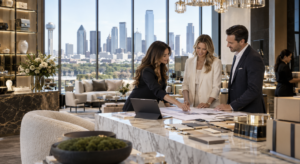
Dallas has spent decades building a reputation as one of the nation’s most important centers for business, real estate, retail, technology, and entrepreneurship. Now another shift is influencing the way the city’s commercial environments are planned. Ecommerce has changed how consumers discover products, compare brands, make purchases, and decide which physical locations are worth visiting. At the same time, luxury brands and growing companies are placing greater value on physical spaces that can create experiences no website or mobile application can duplicate.
That combination is creating new opportunities for architectural interior design throughout Dallas. Retailers, showrooms, offices, hospitality businesses, mixed-use developments, and other commercial properties are increasingly expected to connect physical design with a brand’s broader digital presence.
The trend is unfolding within a sizable market. The U.S. Census Bureau’s Dallas QuickFacts reports that Dallas had an estimated population of more than 1.32 million in 2025 and recorded nearly $31.9 billion in total retail sales in 2022. Those figures provide important context for a city where physical commerce remains substantial even as ecommerce continues to command a larger role in the customer journey.
Ecommerce Is Changing the Purpose of Physical Retail
The rise of ecommerce once prompted widespread predictions that digital shopping would make physical stores far less important. What has emerged instead is a more complex retail environment. Online commerce has become firmly established while physical locations continue to serve an important purpose for companies that want customers to interact with products, people, and brands in person.
According to the U.S. Census Bureau’s quarterly retail ecommerce reporting, U.S. retail ecommerce sales totaled an estimated $1.2337 trillion during 2025, increasing 5.4 percent from 2024. Ecommerce represented 16.4 percent of total retail sales for the year.
For designers and business owners, these numbers matter because the physical store is no longer responsible for performing every part of a transaction. Consumers may first encounter a brand online, research it through search engines or social platforms, visit a physical location to experience its products, and later complete a purchase digitally.
That changes the job of a commercial interior.
A retail location can function as a showroom, an experience center, a consultation space, a pickup point, a content backdrop, or several of those things at once. Architectural planning must therefore accommodate not only inventory and customer circulation but also brand presentation, technology, product demonstrations, social interaction, photography, and changing merchandising requirements.
Dallas Has Become a Natural Market for Ecommerce Growth
Dallas occupies an unusually strong position in the changing retail economy because ecommerce depends on considerably more than a website. Warehousing, distribution networks, transportation, technology, corporate operations, and access to consumers all play a role.
The Federal Reserve Bank of Dallas notes that distribution and ecommerce increased their share of the Dallas economy between 2016 and 2023 and points to the region’s air, rail, and highway connections as factors supporting its emergence as a fulfillment and distribution hub. Major companies including Amazon, Walmart, Target, and Home Depot have opened or expanded distribution operations in the region.
The City of Dallas has also actively recognized ecommerce as an economic development opportunity. The City of Dallas Office of Economic Development specifically identifies ecommerce companies choosing Dallas and cites distribution investments from companies such as Amazon, Ulta Beauty, and Chewy.
This infrastructure creates conditions where a digital brand can establish a larger physical presence and where an established Dallas retailer can expand far beyond its immediate geographic market.
The consequences extend into real estate and design. An ecommerce company opening a headquarters, showroom, flagship location, studio, or customer experience center has different spatial priorities from a conventional retailer developed around shelves and checkout counters alone.
Luxury Design Is Becoming Part of the Brand Experience
As routine purchases become easier to complete online, physical environments have another advantage available to them: experience.
Materials have texture. Lighting creates mood. A thoughtfully planned entrance changes the way someone encounters a brand. Scale, sound, movement, proportion, furnishings, and architectural details influence how visitors perceive a company before they speak with an employee or examine a product.
That is where architectural interior design becomes increasingly significant.
For Dallas businesses competing at the luxury end of the market, the physical environment can communicate positioning immediately. A poorly planned space can conflict with an otherwise sophisticated digital identity, while a cohesive environment can reinforce the same message visitors have encountered online.
Businesses exploring that relationship increasingly look to a Dallas Architectural Interior Designer to consider the architectural character of a space alongside its functionality, materials, lighting, circulation, customer experience, and brand identity.
The objective is broader than decorating an interior. Architectural interior design examines how the space itself works and how its physical elements contribute to the experience occurring inside it.
Digital Brands Need Physical Spaces That Photograph Well
Ecommerce has also altered the visual expectations placed on commercial interiors.
A beautifully designed Dallas space no longer exists only for the people standing inside it. Photographs and videos of that environment may appear on websites, social networks, digital advertising campaigns, online publications, influencer content, product pages, and business profiles.
A single physical location can therefore become a recurring source of digital media.
This has encouraged greater attention to visual composition throughout commercial design. Entrances, displays, wall treatments, lighting, product presentation areas, lounges, consultation spaces, and other elements can become recognizable parts of a company’s visual identity.
The physical and digital versions of a brand increasingly support one another. A customer may see a striking interior on a social platform before deciding to visit. Another customer may discover the location in person and subsequently share it online. That circulation gives architecture and interior design a reach far beyond the property itself.
Dallas Growth Creates More Opportunities for Design
The ecommerce story is only one part of Dallas’ broader business environment.
The Dallas Regional Chamber’s economic reporting showed Dallas regional employment up year over year as of August 2026, while its economic development resources continue to emphasize the region’s broad business base and continuing growth.
Dallas also benefits from a combination of corporate offices, affluent residential areas, hospitality destinations, restaurants, luxury retail, entertainment districts, and mixed-use developments. These sectors frequently overlap. A single project may combine shopping, dining, professional services, hospitality, entertainment, and residential components.
That overlap places greater demands on architectural interiors. Customers expect transitions between spaces to feel intentional. Businesses want distinctive environments without sacrificing usability. Developers need adaptable properties capable of remaining relevant as commercial behavior continues to change.
Rather than creating an interior around a narrow definition of retail, designers increasingly have to consider how people actually use commercial environments now.
The Store Is Becoming a Destination Instead of a Transaction Point
A conventional retail layout often centered on displaying merchandise and completing a purchase. Ecommerce has reduced the need for physical locations to focus exclusively on that transaction.
The modern luxury store may instead encourage visitors to remain longer, interact with products, meet specialists, attend an event, experience a brand story, or receive a level of service unavailable online.
Architecture can reinforce each of those activities.
The American Institute of Architects has highlighted experiential retail design in projects such as Chroma in nearby Fort Worth, where natural light, spatial organization, and a welcoming environment contribute to the customer experience. The project illustrates a broader design principle: successful retail architecture can influence how people feel about occupying a space, not simply how efficiently merchandise fits inside it.
This is particularly relevant for luxury brands. When customers can purchase products from a phone within seconds, there must be another reason to visit a physical destination. Design can become part of that reason.
Architectural Identity Matters in a City Known for Design
Dallas already has an established architectural identity. Its skyline, commercial districts, cultural institutions, neighborhoods, and luxury developments contain work spanning multiple architectural periods and styles. An overview of Dallas architecture and development on Wikipedia reflects the city’s long association with prominent buildings, major commercial development, and distinctive urban districts.
Contemporary interior projects become part of that evolving environment.
For brands entering Dallas, simply reproducing the same generic space used in every market can miss an opportunity. The strongest projects can respond to their specific location, clientele, building, neighborhood, and commercial purpose while remaining consistent with the larger brand.
That is especially valuable in luxury design, where distinction matters.
Flexible Interiors Are Becoming More Valuable
Ecommerce moves quickly, and physical properties increasingly need to keep pace.
A company may change product collections, introduce new technology, host temporary events, develop private client services, expand pickup operations, or alter how customers move between online and in-person shopping. Commercial interiors that cannot adapt may become outdated long before the building itself reaches the end of its useful life.
Flexible architectural planning can help address that reality. Movable displays, multipurpose rooms, adaptable lighting, carefully placed infrastructure, modular furnishings, and open circulation strategies can allow a business to change how it uses a space without completely redesigning it.
This does not mean every commercial interior should appear temporary. Luxury environments can still feel permanent, refined, and highly detailed while incorporating flexibility behind the scenes.
That combination of permanence and adaptability is becoming increasingly important as digital commerce shortens the cycle of change for brands.
Ecommerce and Physical Design Are Moving Closer Together
The most significant development may be that businesses no longer need to choose between ecommerce and physical retail.
The two environments can perform different jobs.
Digital commerce provides reach, speed, convenience, data, and around-the-clock accessibility. Physical spaces provide human interaction, sensory experience, service, atmosphere, and the ability to establish an emotional connection with a brand.
Dallas is particularly well positioned for businesses seeking to combine them. The region offers a substantial consumer market, major transportation infrastructure, extensive commercial development, and a business ecosystem that supports both digital commerce and physical expansion.
Architectural interior designers sit at the intersection of those changes because someone must translate a digital brand into an environment people can physically enter.
Conclusion
Dallas ecommerce growth is not eliminating the need for sophisticated commercial interiors. It is changing what those interiors are expected to accomplish.
Stores are becoming showrooms, destinations, content environments, consultation centers, event spaces, and extensions of digital brands. Luxury companies have greater reason to make their physical locations memorable because ordinary transactions can increasingly happen somewhere else.
For Dallas, that shift arrives during a period in which ecommerce, logistics, business development, and commercial real estate continue to influence the region’s economy. The result is a market where architecture, interior design, technology, and online commerce are becoming increasingly connected.
The next generation of Dallas commercial spaces will be judged by more than appearance alone. Successful environments will need to function efficiently, support changing technology, represent the brand accurately, create meaningful in-person experiences, and remain flexible enough to evolve alongside the companies occupying them.
In an economy increasingly shaped by screens, the physical environment has not lost its value. In many cases, it has become the place where a digital brand finally becomes tangible.